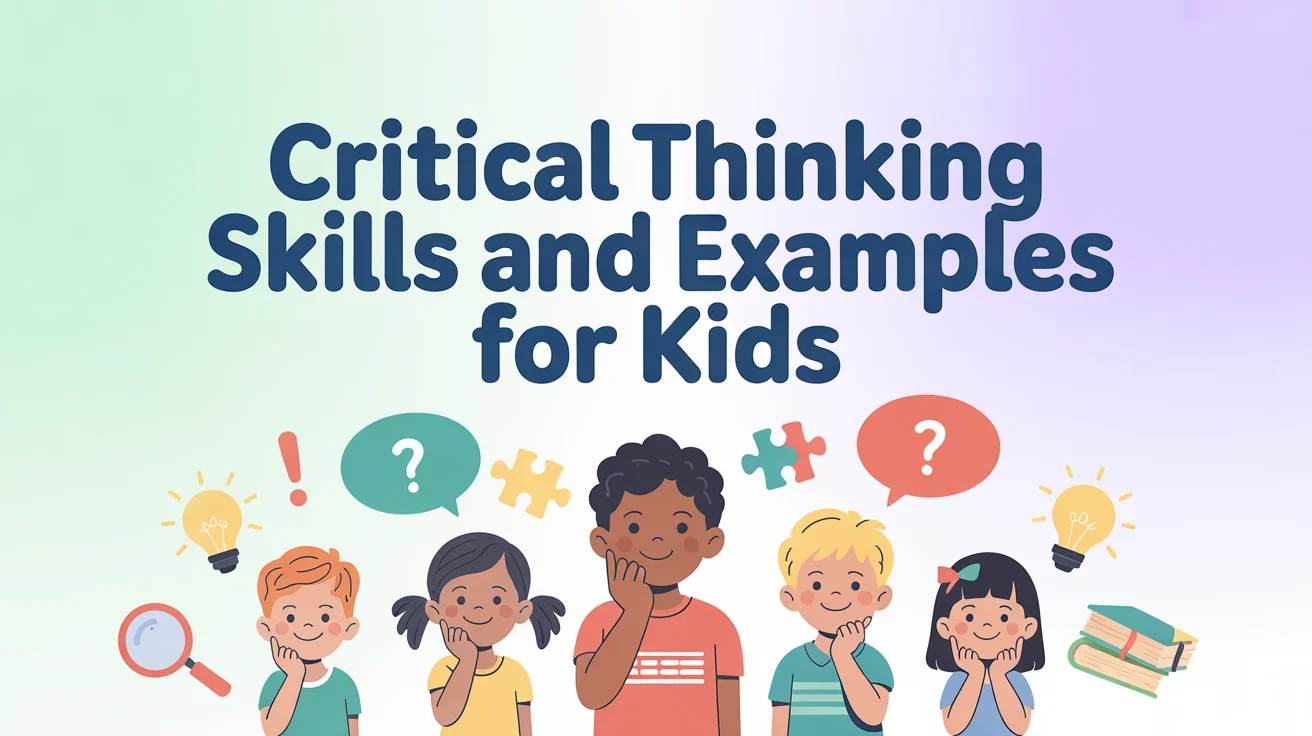
Critical Thinking Skills and Examples for Kids
Today, we’re going to practice using critical thinking skills to solve a fun problem! Critical thinking means using your experience, knowledge, and creativity to tackle complex challenges. With the right strategies, kids can learn to analyze information, organize data, and make smart decisions.
Let’s see how critical thinking works in action with a practical example.
Problem Scenario: Helping Tyler
Tyler has an assignment: he needs to write the sports his classmates play next to their names. The classmates are: Bill, JK, Lisa, and Susie.
The tricky part? Tyler didn’t take great notes, and all of his classmates are on a field trip. That means he cannot ask them again, and the assignment is due today.
Can we help Tyler figure out who plays what sport?
Step 1: List What We Know
Tyler knows there are four sports: basketball, kickball, football, and soccer. He also has some clues:
- JK likes to kick the ball but does not like kickball.
- JK, Lisa, and Susie do not play the same sport as Bill.
- Bill plays a sport that starts with the first letter of his name.
- Lisa enjoys kicking but never scores goals.
- Susie does not like kickball or soccer.
- JK’s mom does not let him play football.
That’s a lot of information, but we can solve it step by step.
Step 2: Organize Information
One of the best strategies for critical thinking is to create a table or chart. This helps visualize the problem and eliminate options.
| Classmate | Basketball | Kickball | Football | Soccer |
| Bill | ||||
| JK | ||||
| Lisa | ||||
| Susie |
We can mark an X for options that are eliminated based on the clues.
Step 3: Apply the Clues
- JK likes to kick the ball but does not like kickball → eliminate kickball and basketball for JK.
- Bill plays a sport starting with B → Bill plays basketball → eliminate basketball for JK, Lisa, Susie.
- Lisa enjoys kicking but never scores goals → eliminate soccer and football for Lisa → Lisa plays kickball.
- Susie does not like kickball or soccer → Susie plays football.
- JK’s mom does not let him play football → JK plays soccer.
Step 4: Final Solution
After organizing and applying all clues, we find:
- Bill → Basketball
- JK → Soccer
- Lisa → Kickball
- Susie → Football
What a fun and practical way to use critical thinking skills to solve a problem!
Why This Example Matters
This activity helps kids:
- Practice logical reasoning
- Analyze and organize information
- Draw conclusions based on evidence
- Build problem-solving skills
Critical thinking can be applied in school, at home, and even in daily life. Activities like this help kids become more independent thinkers.
FAQs – Critical Thinking Skills for Kids
What are critical thinking skills for kids?
Critical thinking skills help kids analyze, evaluate, and solve problems using logic, creativity, and reasoning.
Why are examples important for teaching critical thinking?
Examples make abstract concepts easier to understand and show kids how to apply critical thinking in real situations.
How can kids improve their critical thinking skills?
- Solve logic puzzles and riddles
- Play strategy games
- Practice decision-making exercises
- Organize information using tables or charts
Can critical thinking help in schoolwork?
Yes! Critical thinking helps kids solve math problems, analyze reading passages, and complete assignments more effectively.
At what age should kids start learning critical thinking?
Kids can start developing critical thinking skills as early as elementary school, and it continues to improve with practice.

Allen Haggard
Allen Haggard, a Critical Thinking Expert and Educator, created CriticalThinkingExercises.net to help students, teachers, and professionals improve their analytical, logical, and decision-making skills through guided exercises and practical lessons.